Ludmil Siskov
Bio
Ludmil Siskov
(1936, Sophia / BG – )
Siskov played a prominent role in introducing the pop art mentality in Hungary. After finishing his studies at the Music Conservatory in Sophia, he attended the University of Fine Arts until 1958 and then moved to Hungary. He studied painting at the Academy of Fine Arts until 1963 and stayed in Hungary to work as a restorer. His teacher, Aurél Bernáth, played an important role in his life. Bernáth, a painter and graphic artist, was born in 1895 and was a two-time winner of the Kossuth Award. Siskov’s paintings often contain hidden political messages. His favourite technique is colour photomorphosis. His works have been included in exhibitions in a range of venues and cities, such as Budapest, Venice, and Washington. He participated in the Iparterv exhibitions. Since 1969, he has been living in Austria.
+
IPARTERV Exhibitions
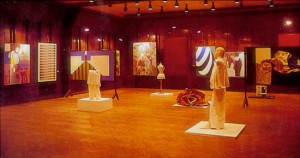 Ludmil Siskov participated at the IPARTERV exhibition in 1968 with his work Astronauts. The exhibition is considered the cornerstone of the history of the Hungarian neo-avantgarde.
The first two exhibitions were organised by Péter Sinkovits art historian in December 1968 and September 1969. In 1980, László Beke and Lóránd Hegyi organised the third ‘edition’, titled Hommage á IPARTERV.
In 1968, the group exhibition was organised in the downtown architect studio of an architect with the participation of 11 artists: Imre Bak, Krisztián Frey, Tamás Hencze, György Jovanovics, llona Keserü, Gyula Konkoly, László Lakner, Sándor Molnár, István Nádler, Ludmill Siskov, Endre Tót. Sinkovits looked back on the aim of the exhibitions in 1980: ”firstly, (we wanted to) show the avantgarde artworks, which were stuck in artists’ workshops before. Secondly, these events encouraged the artists
to express their thoughts and intentions, renewing their motivation and fight against passivity.”
„I wanted to organise the exhibition without a jury, so we expected the overzealous clerks and closed minded directors of the Fine Art Lectorate to hinder us wherever they could […] This moral strength managed to keep the group of friends together for about a year and a half. Erosion started inevitably after that. This was undoubtedly connected to the external pressure that weighed down the entire cultural scene after 1969. […] The avant-garde artists were forced to the periphery of society. They became the most vulnerable social group, while the word avant-garde referred to the forbidden and hidden art. This situation accelerated the disintegration of the IPARTERV group. Ludmill Siskov, Krisztián Frey and Gyula Konkoly left the country by 1970. The following members left somewhat later: László Lakner, Endre Tót, Tamás Szentjóby and László Méhes”. (Péter Sinkovits)
Source: Hommage á IPARTERV 1968/69 I., exhibition catalogue, Fészek Gallery, 1988
World News
1968 in the world
- The economic political reforms known as “New economic mechanisms” are initiated in Hungary.
- In Romania the Autonomous Hungarian Mureş province is abolished. In its place three counties with Hungarian majorities are formed: Covasna, Harghita and Mureș Counties.
- The Budapest Transport Company is established.
- Meeting of communist and workers’ parties from 65 countries of the world in Budapest.
- The civil rights activist Martin Luther King is shot to death in Memphis.
- 1968 was a year of student uprisings. First in Paris students complain about the circumstances of university education, and this leads to disciplinary measures against several students. Following this, a series of protests, riots, strikes and other unrests break out. Because of the brutal behaviour of the police, the unions show solidarity with the students, but they have another set of demands. By May, nearly 5 million French citizens are on strike. For four weeks, there is almost total chaos in France. Finally, Prime Minister Pompidou quiets workers with a significant raise, but the majority of the students’ demands are not addressed. Soon after this, student riots break out in Belgrade and other Yugoslav university towns. Meanwhile, the Prague Spring had begun, and it lasts from January to August. Czechoslovakia, under the direction of Alexander Dubček, strives to establish “socialism with a human face”. In the end, Soviet, Polish, Hungarian and Bulgarian troops bring an end to these efforts and Gustáv Husák is named as the successor of Dubček and the first secretary of the Czechoslovak Communist Party.Stores in Hungary begin carrying Coca-Cola.
- In the United States, Richard M. Nixon wins the presidential elections, taking office in January of the following year.
- The American spacecraft Apollo-8 enters orbit around the Moon with three people on board.
- István Örkény’s book entitled One Minute Stories is published.
- Valentina Vladimirovna Tereshkova, the first female cosmonaut, is selected as the president of the Soviet Women’s Committee.Robert F. Kennedy, the Democratic presidential nominee and brother of John F. Kennedy (who was murdered in 1963), is the victim of a political assassination.
- The first Big Mac is made. It is sold for 49 cents.
Art Life
Events in the art world in 1968
- Tamás Szentjóby establishes the Paralel Course / Study-Track program.
- An exhibition of old and new avant-garde art is organized at the Vásárhelyi Pál College: Imre Bak, Tibor Csiky, Tihamér Gyarmathy, Tamás Hencze, Dezső Korniss, Endre Tót, Béla Veszelszky.
- The first Iparterv exhibition is organized, showcasing works by the leading figures of contemporary avant-garde art, among others Ilona Keserü, Krisztián Frey, István Nádler, Endre Tót, László Lakner, Gyula Konkoly and Ludmil Siskov.
- Marcel Duchamp and John Cage play their legendary musical chess game in Toronto.
- Marcel Duchamp dies.
Design, Lifestyle
Stanley Kubrick – 2001: A Space Odyssey
2001: A Space Odyssey by Stanley Kubrick is both a sci-fi classic and an important milestone in the history of film. Based on the novel ‘The Sentinel’ by Arthur C. Clarke, Kubrick added his own ideas to the screenplay. The film was created in collaboration of the English sci-fi author and the American film director. It was released in 1968, one year before the first manned space craft landed on the Moon. Therefore, the filmmakers had to rely on science and their imagination when creating the storyline, as well as the visual design of the movie. Inspite of all this, 2001: A Space Odyssey is a genuine and fascinating work of art, years ahead of its time. Its enchanting visual effects and fascinating philosophical message are still valid, even in our days.
Kubrick designed every tiny elemet of his movie: he single handedly picked out the fabric for the costumes and used the works of the most distinguished designers of the time.
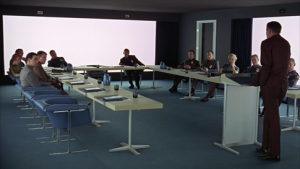
Geoffrey Harcourt, Model 042 lounge chair by Artifort, 1963
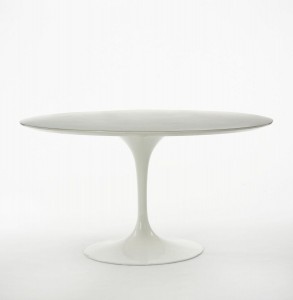
Eero Saarinen, Pedestal table, 1956
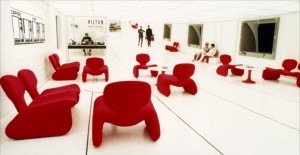
Eero Saarinen, Tulip table, 1956 and Olivier Mourgue, Djinn chairs, 1964-65 in Stanley Kubrick’s 2001 Space Odyssey, 1968
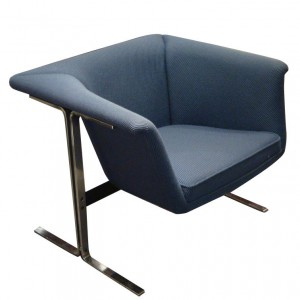
Geoffrey Harcourt, Model 042 lounge chair by Artifort, 1963
Film
1968 and film
- Miklós Jancsó: Csend és kiáltás
https://www.youtube.com/watch?v=Jl-8ShxtDWA

- Péter Bacsó: Fejlövés
https://www.youtube.com/watch?v=fP-CJLIMWLE

- Stanley Kubrick 2001: A Space Odyssey
https://www.youtube.com/watch?v=XHjIqQBsPjk

Music
1968 and music
- Hungária: Repül a varázsszőnyeg
https://www.youtube.com/watch?v=HUKyE1rQy1E

- Omega: Ha én szél lehetnék
https://www.youtube.com/watch?v=Qop7yNv-Mhc
- Metro: Azért is az égben járok
https://www.youtube.com/watch?v=5-3qc-gy2_4
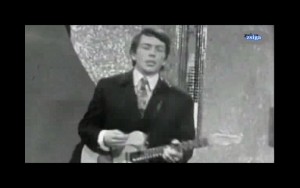
- Illés: Nehéz az út
https://www.youtube.com/watch?v=rTDzogl5sdc&list=PL73PSe-5PCaqkDLVrOQdieUW6z4TE_TOL
