Mimmo Rotella
Bio
Mimmo Rotella
(1918, Catanzaro / IT – 2006, Milan / IT)
Rotella is regarded as a prominent figure of Italian pop art. He began his university studies in art in Naples and then received a scholarship to pursue studies in the United States, which is how he came to attend the University of Missouri in Kansas City. Here he familiarized himself in 1953 with the collage technique, which soon became dominant in his art. Upon completing his studies in the United States, he returned to Italy and moved to Rome, the artistic centre of the country. Here he was inspired by movie posters that had been pasted over one another in several layers, one on top of another, with weather and time causing them to disintegrate, thus presenting contemporary popular culture with an appropriate irony. It was from these old and sometimes less old walls that he obtained posters for his works, posters which he then tore up even more before using them in his pictures. In his later years, he no longer glued poster fragments on his pictures but rather painted over posters. His art is characterized by a vivid and varied use of colour; influences from his time in the United States defined his entire career. In addition to creating works of visual art, he also wrote poetry.
+
The mid 20th century is the golden era of history of film. The posters attracted great masses into the cinemas, despite the fact that televisions could already be found in the majority of households. On the one hand, film posters caught the eyes by emphasising the main characters. On the other hand, posters offered their own intepretation of the story, while evoking the unique atmosphere of the movie. (Miller, Judith: Style and Form, 2007.)
A few film posters from 1965:

Docotr Zhivago, 1965

The Cincinatti Kid, 1965
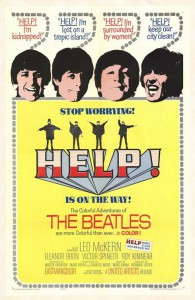
Help!, 1965

Julia and the Spirits, 1965

Thunderball, 1965 (fourth instalment of the James Bond series)
World News
1965 in the world
- At the New York World fair the second time capsule named Westinghouse is buried. According to the plan, it will be opened in 6939
- The United States launches the world’s first commercial communications satellite, named Early Bird. Alexey Leonov performs the first extravehicular activity in space, exiting from the spacecraft Voskhod-2. The Americans didn’t lag behind: Edward White floated around the two-person Gemini-4 using a flare pistol.
- The Central Committee of the Romanian Workers’ Party elects Nicolae Ceaușescu as the successor of the first party secretary, Gheorghe Gheorghiu-Dej.
- The building of the National Theatre on Blaha Lujza square in Budapest is demolished. The authorities explain this decision with references to “city planning issues.” Soon afterwards, on the 20th anniversary of the liberation of Hungary from German occupation, a statue of Lenin is unveiled on Dózsa György Avenue.
- The United States increases its military force in Vietnam while in the same year 35 thousand people demonstrate against the war in Washington alone.
- The construction of the first block housing project built out of elements manufactured by house factories commences (Szakasits Árpád Road 15-25.)
- Winston Churchill and T. S. Eliot die.
- The popular Tom & Jerry cartoon is taken over by television.
- British pop-rock flourishes in America as well. The Beatles’ song Yesterday becomes a global success and the Rolling Stones’ hit Satisfaction comes out.
- Pepsi Inc., later to become the great competitor to the Coca Cola Company, is founded.
Art Life
Events in the art world in 1965
- Kenneth E. Tyler (1931 – ), born in America to a Romanian father and a Hungarian mother, establishes his studio Gemini in Los Angeles. Tyler had an enormous role in the revival and development of post-war limited edition printmaking techniques. Renowned figures of pop art, such as Roy Lichtenstein, Robert Rauschenberg, Jasper Johns and David Hockney among others, often frequented his studio.
- Le Corbusier and Károly Lyka die.
- In the 1960s, various performance events were of great importance. Allen Kaprow made the following claims: “it signified for us the freedom to put together the real world again and again in an unusual format.” The various performances – which abolished the walls between art and life, between the various genres and branches of art – were also shown at festivals. One such interdisciplinary event was the “New York Theater Rally” in 1965, during which twenty-two performances took place, including Oldenburg’s happening entitled Washes.
- Due to economic growth in Italy an economic “miracle” took place in the country, resulting in the percentage of households owning a television to jump from 12% to 49%, a change which would play a key role in the spread of pop culture.
Design, lifestyle
Op Art Movement

Left: Black and white chess board patterned plastic dress, USA, ca. 1965. Right: Harry Gordon, „Poster Dress” paper dress, ca. 1968 (mini dress made of black and white printed fleece)

Vogue title page, 15th September 1965
Besides pop art, ‘op art‘ played an important role in the art scene of the 1960s. The name comes from the abrreviation of ‘optical art’. The expression was popularised by the Time Magazine in 1964, some artists already experimented with geometric playfu elements in the 1950s. The works of Victor Vasarely from a couple of decades earlier were also referred to as op art. The style originated in the abstract expressionist movement, before it overtook other fields, such as interiour design and fashion. Dynamic, geometrical shapes and forms in black and white appear on dresses and clothing items. The exhibition titled ‘The Responsive Eye’ organised by William C. Seitz took place in 1965, and displayed a selection of works from ‘op art’ artists.
Film
1965 and film
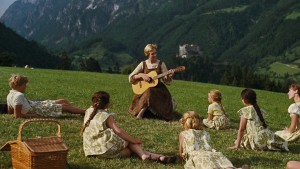
- Robert Wise: The Sound of Music
https://www.youtube.com/watch?v=KuWsQSntFf0
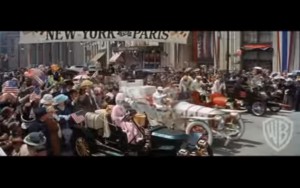
Blake Edwards: The Great Race
https://www.youtube.com/watch?v=9biklE2wA6M
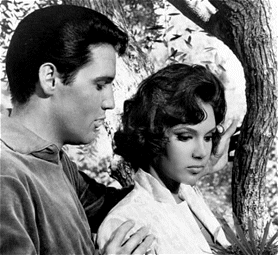
- Boris Sagal: Girl Happy
https://www.youtube.com/watch?v=4zVQdPSWRp4
Music
1965 and music
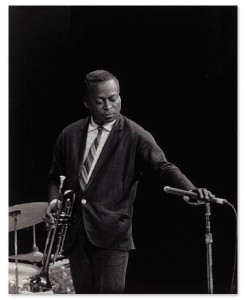
- Miles Davis: E.S.P.
https://www.youtube.com/watch?v=-7taA08bGqk&list=PLGlBvoez9XSPEi7c9ysFtZpoa6Xk_XAOR
- The Who: My Generation
https://www.youtube.com/watch?v=qN5zw04WxCc

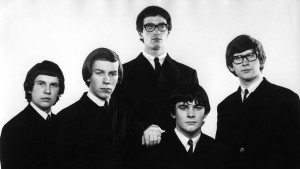
- The Zombies: The Zombies
–https://www.youtube.com/watch?v=g49ckFpRheo