Roy Lichtenstein
Bio
Roy Lichtenstein
(1923, New York / USA – 1997, New York / USA)
Born into a middleclass American family, Lichtenstein became interested in art in his teenage years. Picasso’s Guernica, which he saw in real life, had a profound influence on him. His first teacher was the realist painter Reginald Marsh; Lichtenstein’s opposition to the abstract expressionist style that prevailed at the time soon found manifestation. Lichtenstein placed emphasis on form instead of content. In his thirties, he turned towards pop art for good, and it was at this time that he created his characteristic style, bearing affinities with the world of comics. He strove to make his unique compositions as affected as possible, as if they had been created by a machine in an industrial setting and on an industrial level. One of his goals was to have his works reflect not him, the artist, but the reality of the times and everyday culture, while also caricaturizing everyday culture. His art was inspired by his childhood passion for comics as well as actual publications. For his paintings on war, Lichtenstein drew inspiration from the comic strip Men in War, while for his famous female figures he was influenced by the publication Secret Hearts.
+
Comic…
Superhero comics became very popular during WWII. They provided cheap, simple and lighthearted entertainment, where the good always succeeded. After the war, however, readers gradually lost interest in these stories, so graphic novel artists turned towards other genres. That is why, in the first three decades of the cold war – between 1947 and 1977 – romantic novels took over the market.
The genre itself was created by two graphic novel artists, Joseph H. Simon (Joe Simon) and his partner, Jack Kirby. These two talented artists contributed to the birth of a number of famous super heroes in the golden years of the American comic, starting some time in the 1930s and lasting until the end of the 1940s. One of their oldest and most popular creations was Captain America.
The romatic comics told intense love stories with all the necessary ‘requisites’: jealousy, heartbrake and deceit. The genre can be considered the root of modern soap operas, as it displayed all the usual tools used by the TV series: the stories were full of uncontrollable emotions, sentimentality, tears and happy endings.
Many of Roy Lichtenstein’s famous works were based on romantic novels, such as Secret Hearts or Girls’ Romances – while the artist always adds a taste of irony to his speech bubbles, enriching the meaning of the pictures.

Ohhh…Alright… , Secret Hearts, 88. szám, 1963. június Roy Lichtenstein, Ohhh…Alright…, 1964
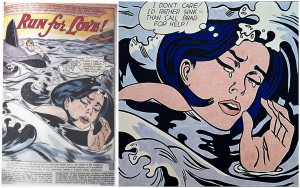
Tony Abruzzo, “Run for Love!” splash page, Secret Hearts, 83. szám, 1962. november Roy Lichtenstein, Drowning Girl, 1963
World News
1965 in the world
- At the New York World fair the second time capsule named Westinghouse is buried. According to the plan, it will be opened in 6939
- The United States launches the world’s first commercial communications satellite, named Early Bird. Alexey Leonov performs the first extravehicular activity in space, exiting from the spacecraft Voskhod-2. The Americans didn’t lag behind: Edward White floated around the two-person Gemini-4 using a flare pistol.
- The Central Committee of the Romanian Workers’ Party elects Nicolae Ceaușescu as the successor of the first party secretary, Gheorghe Gheorghiu-Dej.
- The building of the National Theatre on Blaha Lujza square in Budapest is demolished. The authorities explain this decision with references to “city planning issues.” Soon afterwards, on the 20th anniversary of the liberation of Hungary from German occupation, a statue of Lenin is unveiled on Dózsa György Avenue.
- The United States increases its military force in Vietnam while in the same year 35 thousand people demonstrate against the war in Washington alone.
- The construction of the first block housing project built out of elements manufactured by house factories commences (Szakasits Árpád Road 15-25.)
- Winston Churchill and T. S. Eliot die.
- The popular Tom & Jerry cartoon is taken over by television.
- British pop-rock flourishes in America as well. The Beatles’ song Yesterday becomes a global success and the Rolling Stones’ hit Satisfaction comes out.
- Pepsi Inc., later to become the great competitor to the Coca Cola Company, is founded.
Art Life
Events in the art world in 1965
- Kenneth E. Tyler (1931 – ), born in America to a Romanian father and a Hungarian mother, establishes his studio Gemini in Los Angeles. Tyler had an enormous role in the revival and development of post-war limited edition printmaking techniques. Renowned figures of pop art, such as Roy Lichtenstein, Robert Rauschenberg, Jasper Johns and David Hockney among others, often frequented his studio.
- Le Corbusier and Károly Lyka die.
- In the 1960s, various performance events were of great importance. Allen Kaprow made the following claims: “it signified for us the freedom to put together the real world again and again in an unusual format.” The various performances – which abolished the walls between art and life, between the various genres and branches of art – were also shown at festivals. One such interdisciplinary event was the “New York Theater Rally” in 1965, during which twenty-two performances took place, including Oldenburg’s happening entitled Washes.
- Due to economic growth in Italy an economic “miracle” took place in the country, resulting in the percentage of households owning a television to jump from 12% to 49%, a change which would play a key role in the spread of pop culture.
Design, Lifestyle
Roy Lichtenstein, Lee Rudd Simpson, coat-dress, USA, c. 1965
 Dress with Lichtenstein’s Sunrise (1965) printed on its back and an ivory-colour satin coat. The outfit caused a stir when worn by Lichtenstein’s friend, the American performer Letty Lou Eisenhauer, to the opening for the artist’s 1965 exhibition in Paris. By incorporating his trademark Benday dots and his signature, Lichtenstein in effect created a wearable work of art. It illustrates well that important pop artists of the time, such as Lichtenstein and Warhol, considered fashion a fresh, exciting, new form of art with which the work of art in a gallery could come to life and “step out” into the everyday world.
Film
1965 and film
- Norman Jewison: The Cincinnati Kid
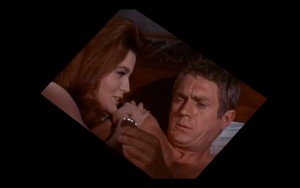
https://www.youtube.com/watch?v=ZIxuNgT2PHU
Cliver Donner / Richard Talmadge: What’s New Pussy Cat?
https://www.youtube.com/watch?v=vTFVJAnv_UA
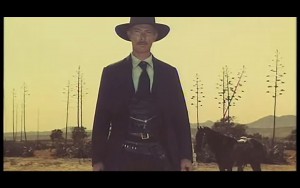
Sergio Leone: For a Few Dollars More (Per qualche dollaro in piú)
Music
1965 and music
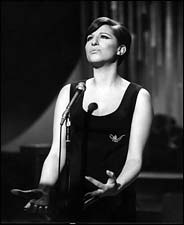
- Barbra Streisand : My Name Is Barbra
https://www.youtube.com/watch?v=oKjBHBjqgnk
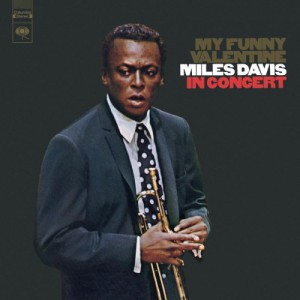
- Miles Davis: My Funny Valentine
https://www.youtube.com/watch?v=hgu28Hqg8Vc
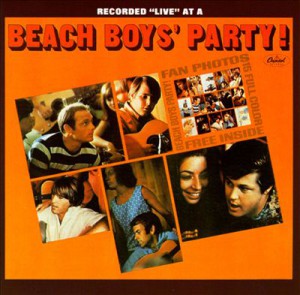
- The Beach Boys: Beach Boys’ Party!
https://www.youtube.com/watch?v=W51j2UxS3Yo&list=PL1660C3E8B3A4936C