Tom Wesselmann
Bio
Tom Wesselmann
(1931, Cincinnati / USA – 2004, New York / USA)
Wesselmann originally studied psychology and only turned towards art seriously in the mid-1950s. In 1959, he participated in the exhibitions of the Judson Gallery together with Daniel Spoerri, Red Grooms and Yoko Ono. His first solo exhibition was organized in 1961 at the Tanger Gallery. Later, in 1963, he participated in the exhibition entitled Pop! Goes the Easel at the Museum of Contemporary Art in Houston. He began his series Great American Nude in the early 1960s, and it brought him significant success. In these paintings his use of blue, red and white are dominant, but other patriotic colours, like gold and khaki, are also found. His depictions of nudes recall certain works by Matisse, who had a profound influence on him. In 1964, he began to increase the size of his paintings and incorporate actual objects into them, such as radiators, lamps, towel racks, ventilators, doors, shelves, and bathtubs. In opposition to these objects, the nudes and their environments remained firmly flat and highly stylized. His figures appear without faces. Parallel to his series Great American Nude he began another series entitled Still Life. The size of the paintings and the objects placed on them (Pall Mall cigarettes, Budweiser beer cans) are reminiscent of the imagery of billboards.
Sources:
- Tilman Osterwold: Pop Art. Cologne, Taschen, 2003
- Ingo F. Walther (ed.): Art of the 20th Century, Cologne -New York, Taschen, 2000
- Kalus Honnef: Pop Art, Cologne, Taschen, 2003
- Aknai Tamás: Egyetemes művészettörténet 1945-1980. Budapest-Pécs, Dialóg Campus Kiadó, 2001
- Lisa Philips: The American Century: Art and Culture. New York, Whitney Museum of American Art, 1999
- Tom Wesselmann / a cura di Danilo Eccher, Milan, MACRO, 2005
+
The Judson Gallery
The Judson Gallery came to life within Judson Memorial Church (a Baptist church), located in the Greenwich Village neighborhood of New York City. By the mid-19th century, the village had the largest African-American community in the city, along with joined German, French, Irish and Italian immigrants.
Founded by Edward Judson in 1888, the church was completed, with the backing of John D. Rockefeller among others, in 1893. The church’s mission has long been self-described as being devoted to social outreach, and establishing programs designed to help those perceived to be in need, despite the controversial or unpopular nature of that help – in the 1950s, the church was the first institution in the village to create a counseling program for drug addicts.
In the late 1950s and early 1960s Judson House was the incubator for radically new art forms.
„Bud Scott, an associate minister at Judson Church from 1957 to 1960, was actively seeking out artists in the Village who were looking for space to work and to exhibit. At the time, Marc Ratliff was living at Judson House as a student attending Cooper Union. When Jim Dine, like Marc from Cincinnati, came to New York, he looked up Ratliff and the two started hanging out together. Another Cooper Union student from Cincinnati, Tom Wesselmann, joined them, and the three young artists, along with Bud Scott, hit on the idea of opening a gallery in Judson House”. Around 1957, the church offered gallery space to Claes Oldenburg, Jim Dine, Robert Rauschenberg, later to Tom Wesselmann, Daniel Spoerri, Red Grooms or Yoko Ono. After Scott, Al Carmines continued this special mission but with a focus on performing arts. It was not until 1967 that the Judson Gallery was revived by Jon Hendricks, interested in art activism. In the spring of 1968 the gallery organized the Destruction in Art event that had an influence far beyond Judson and the Village. The church’s involvement in the visual arts stopped when other venues became available, but Judson’s great contribution to the arts was the absolute freedom it granted to the artists.
Source: Judson Memorial Church online
World News
1964 in the World
- The United Stated gets involved in the war in Vietnam, which ends approximately a decade later.
- After getting rid of Nikita Khruschev, Leonid Brezhnev takes the position as the general secretary of the CPSU
- The first Chinese nuclear explosion.
- The new Elizabeth Bridge is inaugurated in Budapest (designed by Pál Sávoly).
- Nobel Prize for Martin Luther King and Jean-Paul Sartre: the latter refuses his award due to his belief about the author.
- Nelson Mandela is sentenced to life in prison in South Africa. He is freed in 1990.
- The song titled ”I Want To Hold Your Hand” by The Beatles is top of the charts in America, starting the ‘British invasion’ in music.
- Life sentence is abolished in the United Kingdom.
- The first Ford Mustang is produced.
- Historical visit of John Paul IV in Jordan and Israel: he is the first Catholic leader to visit the Holy Land.
- The first self-service supermarket of Hungary opens in Dorog.
Art Life
Events in Art History from 1964
The 1964 Venice Biennial brings American pop art to Europe: Robert Rauschenbergnek wins the grand prix of the biennial. Apart from him, Jasper Johns, Jim Dine and Claes Oldenburg represent the genre. At the same time, the gallery owners Leo Castelli and Ileana Sonnabend organise a pop art exhibition at the American embassy in Votol, San Gregorio, as a manifestation of America’s fascination with pop art. Rauschenberg’s award caused controversy among the members of the international jury, some of them mentioned ”cultural colonisation”. The sensationalist media frenzy around pop art left the other exhibitions in the shadow.
Design, Lifestyle

Allen Jones, Table, Hat Stand and Chair, 1969
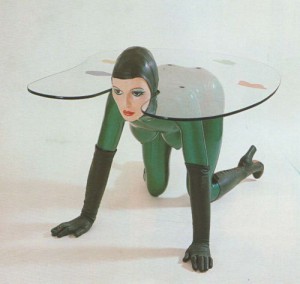
Allen Jones, Body-Table, USA, 1969
The erotic furniture design of the British designer Allen Jones broke up with the conventions through its provocative nature. The scantily clad female figures as ”pieces of furniture” loudly and successfully challenge traditional values of art and society. The works were inspired by mass culture, as it was usual for pop art. The bold furniture-statues reached international fame, and were referred to as the emblems of the 60s. The fetishist statues provoked strong opposition, especially from feminist groups. (It is said that they protested with stinkbombs at the opening in the Institute of Contemporary Arts (ICA) in London.) The works by Wesselmann shown at the Ludwig Múzeumban are from 1964/65, his later oeuvre contains erotic female figures, as well.
Source:
Gyula Ernyey: Design (1750-2000). Budapest, Ráday Book House, 2010.
Fiell, Peter – Fiell, Charlotte: 1000 Chairs. Cologne, Taschen, 2005.
Film
1964 and film
- Andy Warhol: Empire
https://www.youtube.com/watch?v=VMCeDBn1Zu0

- Michelangelo Antonioni: Il deserto rosso
https://www.youtube.com/watch?v=CvKufXFumfI
- Federico Fellini :8 and ½
https://www.youtube.com/watch?v=RmIC9pQ80Fk
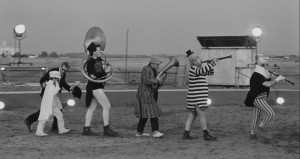
- Jean-Luc Godard: Une femme mariée
https://www.youtube.com/watch?v=g3_Z3vsdjKk
Music
1964 and Music
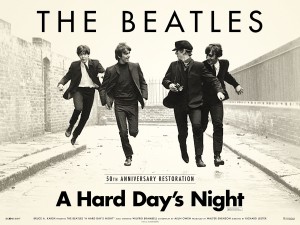
- The Beatles: Hard Day’s Night
https://www.youtube.com/watch?v=65n2xZuSgII&list=PL7FEC9F0D3BAD2CDD
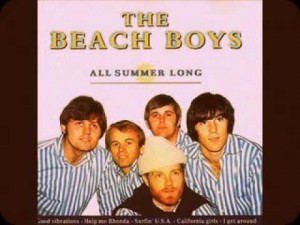
- The Beach Boys: All Summer Long
https://www.youtube.com/watch?v=2tytTebj8ic
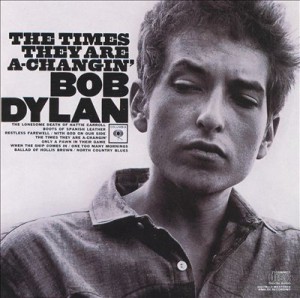
- Bob Dylan: The Times They are a Changin
https://www.youtube.com/watch?v=e7qQ6_RV4VQ